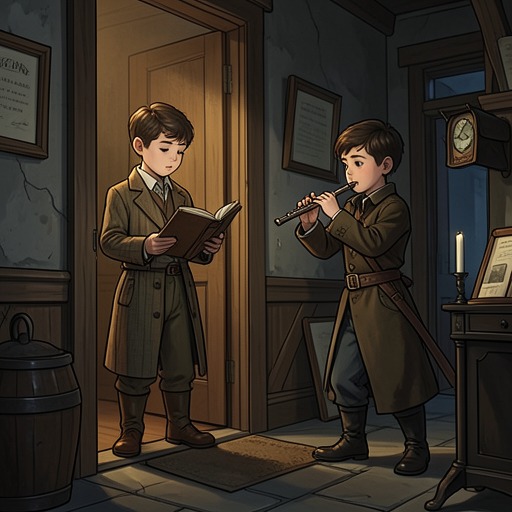
Marionette Theater
The Adventures of PinocchioThe Marionette Theater is the setting for Pinocchio’s first encounter with a crowd of Marionettes who recognize him as one of their own. Their joyful welcome briefly makes the stage a place of belonging, but Fire Eater’s abrupt arrival exposes the danger beneath its spectacle: the director can overrule the performers’ celebration and put Pinocchio’s life at risk.
Setting and Recognition
Pinocchio enters the theater after the book he was meant to take to school has changed hands. Once the performance is under way, the Marionettes recognize him as their brother. Instead of continuing their act, they cheer, lift him onto their shoulders, and carry him around the stage in triumph. The interruption begins as an exuberant welcome: the theater’s performers recognize Pinocchio through their shared wooden nature, and the stage becomes a space in which he is received as kin.
Fire Eater’s Authority
The celebration stops when Fire Eater appears. His entrance is marked by an imposing, frightening appearance: a beard reaching from his chin to his feet, a huge mouth and glowing red eyes, and a long whip made of twisted green snakes and black cats’ tails. The Marionettes tremble, and the crowd falls silent. Against their collective delight, Fire Eater’s command of the theater is immediate; he confronts Pinocchio for bringing excitement into the performance. The scene turns the stage from a place of communal recognition into one where the director’s power threatens the newcomer.
The Theater in Pinocchio’s Recollection
When Pinocchio later finds Geppetto inside the Shark, he recounts the theater episode as part of a longer account of his misfortunes. He remembers that after Geppetto sold his coat to buy him a schoolbook, he ran away to the Marionette Theater, where its proprietor caught him and wanted to burn him to cook roast lamb. Pinocchio also recalls that the proprietor gave him five gold pieces for Geppetto. In that retelling, the theater marks the first turn in a chain of adventures: the money does not take Pinocchio home, and his departure leads instead to further encounters and danger.
Performance, Belonging, and Danger
The theater’s brief transformation from performance venue to site of welcome depends on the Marionettes’ response to Pinocchio: they abandon their act and make him the center of the stage. Fire Eater’s intervention reverses that moment, showing how quickly recognition can be subordinated to the authority controlling the spectacle. Later, Pinocchio’s recollection preserves both sides of the episode—the welcome of the Marionettes and the threat posed by their proprietor—within the story of his repeated departures from the path toward school and home.